Chemical Biology at UF Scripps
Small molecules.
New paths to
drug discovery.
We combine small molecules, proteomics, and functional genomics to uncover new biology and therapeutic opportunities.
Xu lab · Chen et al., Science, 2021 · Camera motion.
Chemical control: our JACS study ↗
Small molecules × Proteomics × Functional genomics · UF Scripps · Jupiter, Florida
01 / Our science
Curiosity at the
molecular scale.
We bring together small-molecule discovery, chemical proteomics, and functional genomics to reveal new biology and open paths to drug discovery.
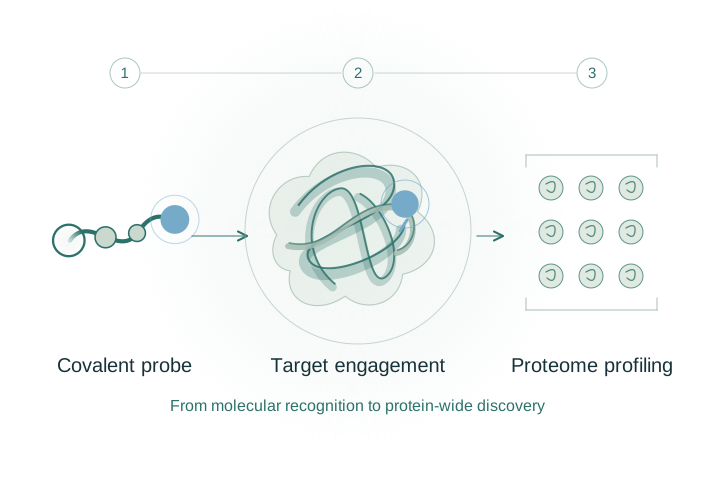
01 / Chemical proteomics
Chemical Proteomics & Covalent Ligand Discovery
We design chemically and stereochemically diverse small molecules to explore ligandable sites in native biological systems.
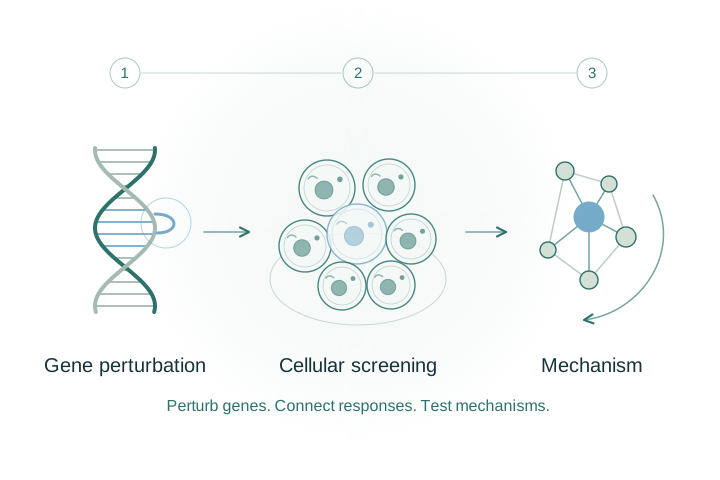
02 / Functional genomics
Functional Genomics & Mechanism of Action
We combine CRISPR screening with focused genetic perturbations to connect compound activity to its biological mechanism.
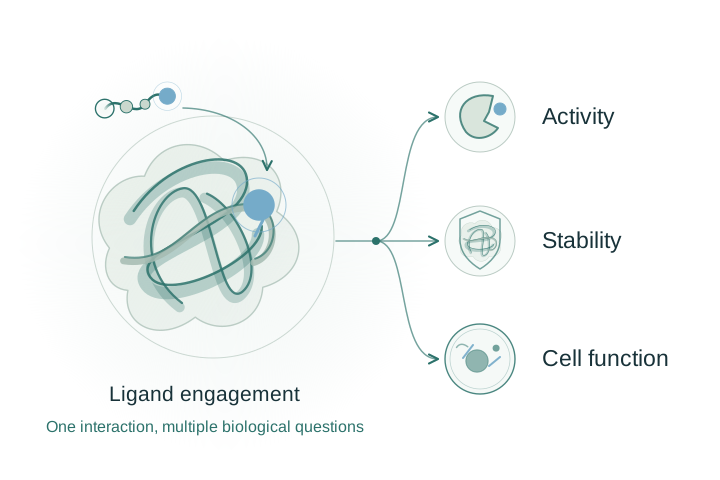
03 / Protein modulation
Protein Modulation & Disease Biology
A ligand can do more than block an active site.
Research in focus / JACS 2024
A chemical handle
on transcription.
How can a small molecule change the fate of a protein in the transcription machinery? Our work identified covalent degraders of ERCC3 / XPB, a key component of TFIIH.
From chemical discovery to protein fate
01
Start with small molecules.
Spirocycle acrylamide stereoprobes explore new chemical space.
02
Read the proteome.
Chemical proteomics maps covalent engagement of ERCC3 / XPB.
03
Resolve the mechanism.
Genetic disruption of FBXL18 blocks ERCC3 degradation by ZL-12A.
One target, distinct outcomes: ZL-12A and triptolide engage the same cysteine but produce different protein degradation profiles.
Read the paper
Liu et al. · J. Am. Chem. Soc. 2024
02 / Selected publications
Ideas that move
science forward.
-
An Allosteric Cyclin E–CDK2 Site Mapped by Paralog Hopping with Covalent Probes
Nature Chemical Biology, 21(3), 420–431 · 2025
-
Coordinated Inheritance of Extrachromosomal DNAs in Cancer Cells
Nature, 635(8037), 201–209 · 2024
-
Proteomic Ligandability Maps of Spirocycle Acrylamide Stereoprobes Identify Covalent ERCC3 Degraders
Journal of the American Chemical Society, 146(15), 10393–10406 · 2024

03 / Beyond the bench
Good science.
Great company.
Shared curiosity brings us together. Conversation, collaboration, and time outside the lab keep us connected.
04 / Lab notes
The latest from the lab.
We are hiring postdoctoral researchers
Candidates with expertise in molecular biology, cell biology, or cancer biology are especially encouraged to apply.
The Liu Lab is officially open at UF Scripps
The Liu Lab has launched at UF Scripps in Jupiter, Florida.
Join the Liu Lab
The next discovery
starts with you.
We welcome curious, collaborative researchers interested in chemical biology, proteomics, functional genomics, cancer biology, and drug discovery.